West African Dance - Mande dancing
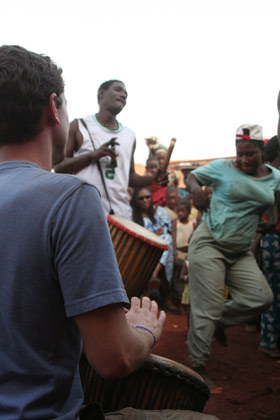
Paddy Cassidy plays solo for a dancer at a
circumcision in Bamako, Mali
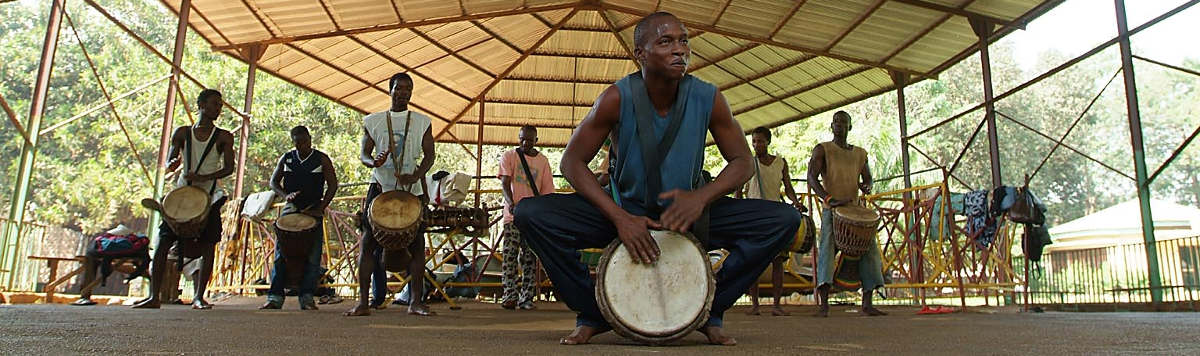
Traditional dances from the Mande region of West Africa are some of the most popular African dances studied outside of Africa.
The dances accompany specific drumming rhythms; each rhythm has a particular set of steps, though there is often room for embellishment or introduction of new steps.
During public events the participants form a circle with the drummers at the head, or in the center.
Dancers emerge by themselves (or in groups of 2 and 3) and approach the drummers to dance for a short time before returning to the circle again.
Djembe soloing is used to accentuate the dancer's steps when they approach the drummers, and often dancers try to incite the drummers to play certain phrases, or to keep up with their steps. This can clearly be seen in the video below. In fact in this case you will notice that the sangban player is also marking the dancers steps on certain occasions.
Notice the djembe and dundun drums marking out and accentuating the dance steps during a 'dance solo'
Those in the circle may clap and singing is often a repite when the intensity drops.
The circle is all inclusive and as a part of the circle you can see, experience and be a part of what is happening.
A circle however, is not so useful when it comes performing on a stage for an audience who are not participants.
As such, at some point in the late 1940's or early 1950's when Fodeba Keita formed Les Ballets Africains, the traditional circle was adapted by spreading it out into lines, which is now associated with ballet style performance.
This has led to 2 distinct styles of dance choreography among the Maninka.
a village tradition which may also continue in towns and cities.
the ballet tradition where rhythms and dances that would not usually be mixed are combined and choregraphies are created using western ideas of stage presentation and group choreography.
Here's an example of Ballet Style Dundunda dancing from Les Ballet Africains
In this culture dancing is for everyone, even though a few excel.
Some dancing is viewed as play (tulon) or entertainment (nyenaje). Other occassions for drumming and dancing are very serious. With a few exceptions drums are the instruments of choice for dancing.
Traditionally drum rhythms and their dances would have been associated with specific occassions, with each rhythm having a time and place. These days rhythms and dances may be performed at a wider range of events.
Drumming is a communal event that demands participation from everybody in some form whether it be clapping, singing or dancing. By participating you honour the people being celebrated.
Often steps are symbolic or derived from every day activities. Here's Mory Traore demonstrates a step from Soko, that comes from washing clothes and placing them on the washing line.
African dance has become very popular around the world for many reasons. It is very dynamic and fun yet can be very accessable to those with little experience.
A great smile is always a valuable asset
Like everything the best way to learn is from an experienced teacher but it may not be possible because in many countries teachers are not available at this moment in time.
For those who don't have access to a teacher and don't want to travel to West Africa, there are a number of dancing instructional DVDs available and it is possible to learn traditional dances from these.
If you would like to learn more about West African dance, come and join the discussion.
<< Back to resources
Sources: Mande Music - Eric Charry - ISBN - 0-226-10162-2
What is your experience of African dance?
Djembe culture articles
Our djembe culture articles aim to fill in some of the culture behind this music and these dances.
These include information on the history of the djembe, it's traditional role in Mande society, the Jeli's, African dance etc.

Djembe & drum equipment articles
Our djembe drum and equipment articles aim to provide you with the practical information you will need in order to look after your equipment, how to pick good drums and service them correctly.
Our details
Mobile / Cell:
+49 1 785 90 70 70
Address:
Friedel Str
Kreuzberg
Berlin Germany
Djembefola © 2006 - 2015