
A Guide to Buying a Djembe
Recognising Gems and pitfalls: A guide for the first-time buyer
A big part of what makes a good djembe simply depends on your style and preference. There are a lot of good djembes out there, it's just a matter of finding one (or two, or three) that suit you.
If you're a first-time djembe buyer, I would recommend buying one from a seller that allows you to test it out first. It is not advisable to buy one online except from a reputable seller. If you met your spouse through an online dating service, then you can disregard the last comment.
Not all djembes were created equal, however, and there are a lot of low-quality drums out there, made quickly and carelessly for unsuspecting tourists. Playing one of these can be very discouraging, because, well, they sound awful no matter how well you play. You may even hurt your hands on a drum that isn't carved properly, which is why it's especially important that beginners pick out a good starter drum. We would hate for your love of djembe to fizzle out in the aftermath of bruised hands.
I'll point out several factors that make up the overall quality of a drum. These would be: the wood, the shape/carving technique, the skin and the hardware.
The Wood
There are a number of woods that are suitable for djembes. The best drums are made from a small variety of West African hardwoods. The wood traditionally used for djembe is Lenke, due to its acoustic and spiritual properties, however, nowadays there are a number of other types of wood that are commonly used.
In general you'll want to stay away from soft woods. If you can press your fingernail against the wood and make an indentation, then the wood is too soft. Your djembe will endure a lot of wear and tear over its lifetime, from the extreme pressure of the rope and skin, from being carried around and being tuned and re-tuned. A drum made from soft wood will be much less durable and will deteriorate over time, even to the point of cracking or splitting.
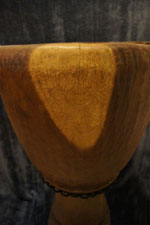
Here you can see lighter coloured sapwood
Another factor to look for in a shell, though of lesser importance, is the presence of sapwood. What is sapwood, you may ask? It is the outer section of a tree, lighter in color than the interior heartwood. It is most commonly visible at the widest part of the drum, up near the top of the bowl. When a tree is alive, sapwood is the living part, carrying water and nutrients through the trunk like veins and arteries through the body. Heartwood functions as the structural backbone. As the tree ages and grows, sapwood slowly dries out and hardens, becoming heartwood. When cutting lumber for woodworking, the sapwood is typically scrapped, since it contains more moisture and is therefore prone to warping and splitting as the wood dries out. It is also more susceptible to fungus. Many djembes have some sapwood visible somewhere on the shell, but the finest djembes are made completely of heartwood.
The Form
There isn't one single correct shape for djembes. There are a number of regional variations that can occur in the shape of a drum, and I can usually identify where a drum is from based on its shape and the technique used to carve the drum. A proper form is one of the most important factors to look for in a djembe, but also one of the most difficult for beginners to identify. I'll try to break it down a little bit here.
Proportion
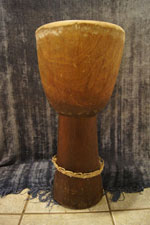
This drum is slightly disproportionate, with its long stem
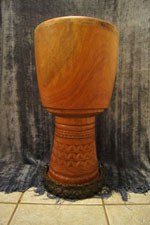
This drum has a properly proportioned bowl and stem
The basic element of form in a djembe is proportion. There is no formula for proper proportion, but there are several basic guidelines to follow. The bowl and horn should be somewhat comparable in length. Beware of a drum that has a short bowl on a long stem, or vise versa.
Thickness/Integrity
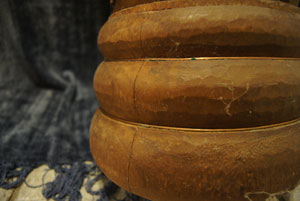
This drum has had some repairs done
Be sure to inspect the shell for cracks, or for large patches of wood putty. Hold the drum up to a light and look into the horn. Do you see any light coming in? If so, don't buy the drum. While a few small, minor surface cracks may be acceptable, beware of any crack that is at least an inch, or which passes through the width of the shell. This type of crack will grow larger over time. A sizable crack or hole in the shell will allow air to escape, and you will never get a decent bass sound. Finally, the shell should be of uniform thickness throughout.
The playing edge
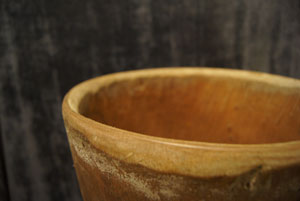
Don't play the drum above for too long; you could hurt yourself! Look for a drum with a smoother playing edge
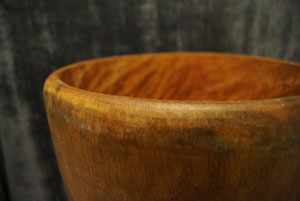
A drum with a smoother playing edge
Along the rim is where your hands make the most contact with the drum. This aspect of a djembe is immensely important to the overall quality of the drum, for this is what gives a drum its feel. The playing edge should be round, and not too sharp or too wide. It should also be level and smooth all the way around. Run your fingers along the rim of the drum to feel for any unevenness or bumps. This should be avoided.
The sound hole
The sound hole, or throat, is the circular opening from the bowl down into the horn of the djembe. It plays a large role in determining the relative pitch of the bass note of the drum. The wider the sound hole, the higher the bass note. A very narrow sound hole will produce a very deep bass, but if it's too narrow, it can be almost inaudible. If you're a drum circle drummer, then you may be looking for a deep, deep bass. However, drummers who play with musical ensembles will want a bass note that can be heard through the ensemble. Malian drums tend to have wider sound holes than Guinean drums. My personal preference is for the wider hole, because it gives the bass note a more audible punch.
Roundness
Check to see that the drum is round. While this may seem obvious, keep in mind that many drums will warp slightly over time, and become more oval. This is especially true with softer woods. If you can't tell whether or not the drum is circular, grab a section of rope and roughly measure the diameter of the head. Then, turn 45 degrees and measure again, and repeat the measurement until you have gone all the way around the head.
Smoothness
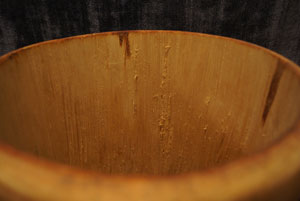
This first drum was the victim of a chainsaw attack!
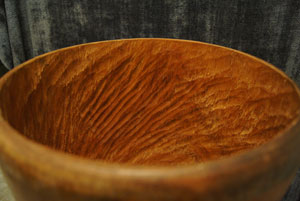
The second drum demonstrates the proper spiral pattern inside the bowl.
A quality djembe will be smooth all around its exterior, with only the gentle texture provided by the carver's hand tools. If the drum is perfectly smooth, then it was likely turned on a lathe. While this may make a decent starter drum, discerning djembe players tend to shun lathe-turned djembes. Why? The interior of a traditionally-carved drum is not perfectly smooth. It has a spiral groove pattern which gives the drum its unique voice. Factory-produced and lathe-turned drums lack the uniqueness of a hand-carved drum. If the drum you're looking at is already headed up, reach your hand up into the bowl and feel the wood inside the bowl. Do you feel the spiral pattern? Or is it smooth? Perhaps it has deep, straight grooves, such as those made by a chainsaw. Avoid this type of drum if possible.
Size
The proper size of your drum depends on the size of your hands and body. For someone with small to medium hands (5”-7” from the base of the palm to the tip of the middle finger), you'll want to look at a drum that's between 11” and 13” in diameter. Anything smaller, and you'll have trouble getting decent tones and slaps. For someone with large hands, you can go as large as 14.5”. If you are a complete beginner, then you may want to err on the side of caution, and choose a smaller drum.
Decorations
You may be tempted to select your djembe based on the decorative carvings along the horn. While they may be beautiful, remember that they are purely aesthetic and do not affect the sound of the drum. Nonetheless, you should choose a drum whose carvings appeal to you, since they're there to stay. If given a choice between two drums of equal quality and proportions, then the decorations will likely be the deciding factor.
Construction
If you are purchasing a drum that has already been put together, then you will want to look closely at how carefully the drum head was attached. A poorly built drum will soon need to be re-built, otherwise you will not be able to attain a clear, crisp sound. The cost of rebuilding a drum can be quite high, so it is worth spending a little extra money at the outset to find a drum that has been properly constructed.
The skin
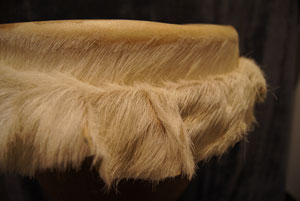
Inspect the skin for any holes. Does it look and feel like a natural animal hide? If so, what kind? Does it look white, like it has been bleached? These tend not to sound as good as a shaved skin. As you tap your fingertips gently on the skin, does it give a warm, natural sound, or a synthetic, plastic sound? Press your hand into the center of the drum head. Is it flexible? If so, then it is probably not tuned very high. You will be able to tune your drum if you know how, unless there are problems with the construction of the drum, which I will address shortly. Finally, is the skin trimmed neatly, or does it have a jagged, uneven edge? These are all factors to examine.
The hoops
These hoops are nearly 3” (7.5 cm) below the playing edge of the drum...not good!
How close are the metal hoops to the rim of the drum? They shouldn't be much wider than the outside diameter of the drum itself. As such, they should sit just below the playing edge. If there is a large gap between the playing edge and the metal hoops, then the hoops are not fitted properly. You may need to get the hoops re-sized, or at the very least, re-wrapped, so that they tightly hug the outside of the drum. If the hoops flare out from the drum, and you can fit your fingers between the metal hoops and the surface of the drum, then they are way too big. The drum will not stay in tune properly.
The rope
Finally, inspect the rope that holds the skin in place. It should be smooth and new. If the rope is frayed, then it may be old and weak. You should only see a few knots on the drum; generally, one on each of the hoops, and one on the bowl. If there are more, it may indicate that the rope has been broken and re-tied. Does the diamond pattern look neat and uniform, or does it look messy? If you pull on the rope, does it stretch? Ideally, your drum rope should not stretch at all. If it is stretchy rope, then the drum will not stay in tune for very long.
Conclusion
In summary, pick your drum carefully. If you are willing to spend a little extra, your drum should last longer, sound better, and feel better, too. Happy drumming!
Paddy Cassidy is a djembe player and teacher based in Wisconsin, US, and frequent contributor to Djembefola.com.
Related Articles
Sharu01 says:
Hi Thank You for your articles, every moment that read this section Im learning very insteresting thing.ssblessings
skarakatic says:
Very good and useful. If i know all the recommendations in this article in september...... Well, i mus bya new djembe. :-(
skarakatic says:
Very good and useful. If i know all the recommendations in this article in september...... Well, i mus buy a new djembe. :-(

Find out about our latest media first!
We release new articles all the time. Have them delivered to your mail box for free!
Fatal error: Cannot redeclare curPageURL() (previously declared in /home/solas/public_html/board/includes/functions.php:4889) in /home/solas/public_html/templates/footer.php on line 13
James says:
This is a really interesting read. Well done Paddy.