- Sat Aug 05, 2017 6:15 pm
#37857
From what I've seen online, Michi's right, the grain pattern and color don't match Dugura/Dimba.
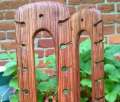
Note how buttery smooth the heartwood looks, and the patterns are barely visible?
Dugura typically has visible waves and ripples, due to alternating opaque/transparent color layers within the wood, as well as a rougher texture. I have two Dugura and they look very much alike, both medium orange (not dark red or purple at all) with wavey light/dark grain patterns. The transparent layer is rich orange, the light layer is milkier in color. It's fairly distinct, although occasionally other species can look like it, it rarely looks like other species.
I've seen two Kangaba Lenke djembes in person, and it looks exactly like that. The wood is buttery (it even feels buttery smooth to the touch) and the patterns are faint or nonexistant.
Gueni on the other hand usually has noticeable blurry streaks of lighter and darker. Not as wavey as Dugura, or as sharply contrasted, instead it usually has fairly straight lines of shade variaton. The pores are smaller on Gueni too, whereas this one clearly has large pores (visible in the sapwood), also consistent with Lenke.
And finally, the color. It's consistent with the color of Lenke, which tends to be a brownish burgundy or port color. Gueni tends to be maroon color, with more purple, and less brown than Lenke. It's a subtle difference, and some Gueni is very brown, so it's not reliable, but generally true. Gueni can come from different Pterocarpus species, and Lenke can come from various Afzelia species. Appearance varies from piece to piece, so there's no sure answer unless the vendor knows.
But I'd say this is very likely Lenke.
At $80 this was a great buy. The sapwood on hardwoods tends to still be fairly hard, and the compression for the bass happens lower in the bowl anyway, so the heartwood should still be helpful lower down, due to it's higher density. It will also make the stem more durable, which gets the most wear and sometimes split. The heartwood also extends further up on the inside, as you may have realized. (could be more than a couple inches, maybe 3-4 depending)
You can use a flashlight to see just how far up it goes.
Looks great, lucky find.